In a world of digital pets with built-in webcams, smart pajamas that monitor the regularity of our body's functions, and even wearable devices that will scan your skin and tell you how much sun exposure you experienced in a day – there seems to be no limit to what we can accomplish with technology today.
The same is (supposedly) true of home security. AI-powered surveillance systems, robotic monitoring, and complete home automation programs you can control with the push of a button from your smartphone mean peace of mind has never been more accessible.
But is it really making us feel safer? From the components that make up your internal home security to the safety of our streets and communities, we surveyed over 1,300 people to find out what helps put them at ease about the world around them. We asked them to rank everything from deadbolts to firearms to find out how gadgets helping people feel secure vary based on age and location. Read on as we break down how well emerging security trends stand up to conventional design.
Creating a Safe Environment
All the best security systems in the world and high-end smart home technology won't get you very far if you don't actually feel safe inside your own home. Experts suggest it isn't uncommon to confuse our feelings of security with our level of genuine protection, so it's important to recognize what triggers our perception of safety.
More than anything else in their home, nothing made Americans feel more confident in being danger-free than a trusty deadbolt on the front door. And even though the deadbolt has gotten a bit of a facelift with modern technology in recent years (including app-controlled "smart keys"), it was the conventional style that instilled the deepest sense of safety in people polled.
And perhaps because the adage "if it isn't broke, don't fix it" really does apply to almost everything, a vast majority of people identified classic elements of home security as making them feel most safe: video surveillance systems (92.6 percent) and alarms (90.2 percent). As long as they're armed and ready to go, burglars admit a clearly identified home security system will send them on their way if they're scoping out a potential target.
Environmental Awareness
No matter what your preference is for personal security, from deadbolts to smart systems to dogs (who can act as both alarms and deterrents to intrusion), people at least have some level of control over how safe their homes are. The same can't exactly be said for where you live, and even though we may not always have the best measure on just how crime-laden our communities are, reports of local burglaries or assault play a major role in how safe people feel in their own homes.
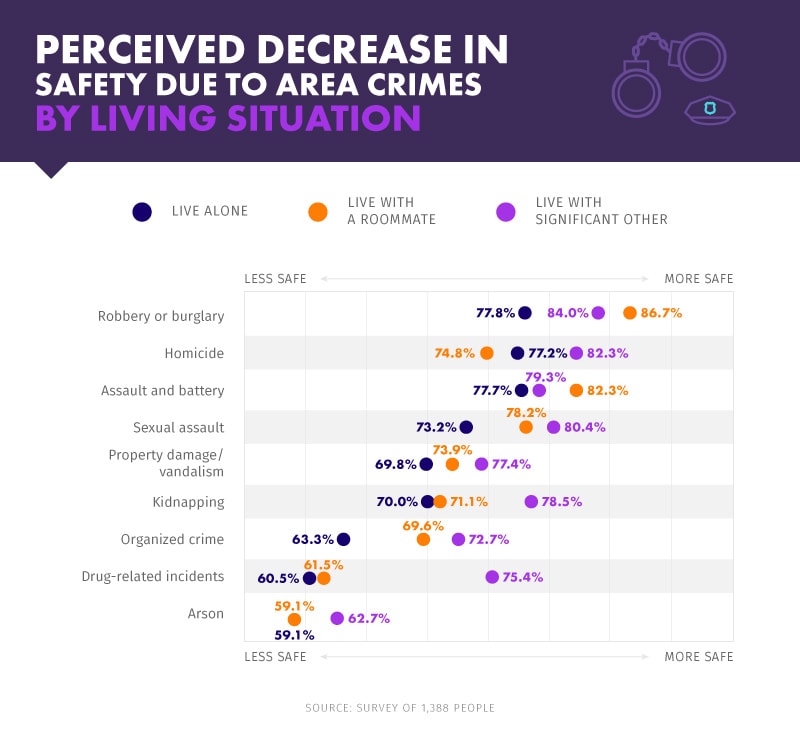
More than homicides or assault cases, reports of robberies made people feel less safe regardless of their living conditions. Having company around may help ward off the feelings of insecurity, though. People living alone (78 percent) were more worried about reports of break-ins than people who lived with their significant others (84 percent) or with a roommate (87 percent).
And while arson, drug-related incidents, and organized crime were generally the least concerning crimes when it came to feeling protected, sexual assault was even more worrying to people living alone (73 percent) than it was to men or women living with either a roommate (78 percent) or a significant other (80 percent).
Out and About
No matter where you live, there are plenty of ways to make sure you're taking every precaution when you're walking around outside, particularly if it's dark or deserted. Lighting the way if you're going for a jog, staying in larger groups wherever possible, and avoiding distractions like your cellphone are easy ways to make sure you're fully aware of everything happening around you. But how far will those recommendations go if you aren't actually worried about the dangers of being out by yourself?
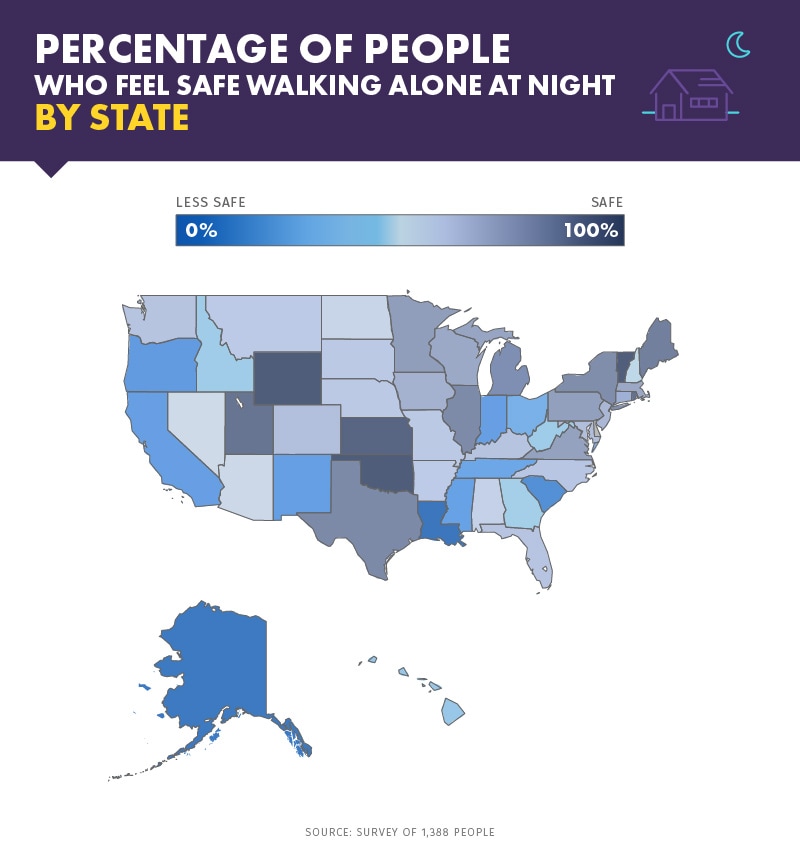
More than anywhere else in America, close to 93 percent of people living in Oklahoma and Wyoming said they felt perfectly safe walking alone at night. In contrast, we found people from Southern states like Louisiana and South Carolina, in addition to areas on the West Coast like California, Oregon, and New Mexico, we found people were the most worried about the dangers that might be lurking in the shadows. Regardless of how you might feel, it's important to recognize the potentials that could occur in the blink of an eye. Crime maps are a powerful tool for understanding when and where it may be safe to go out by yourself.
Defensive Measures
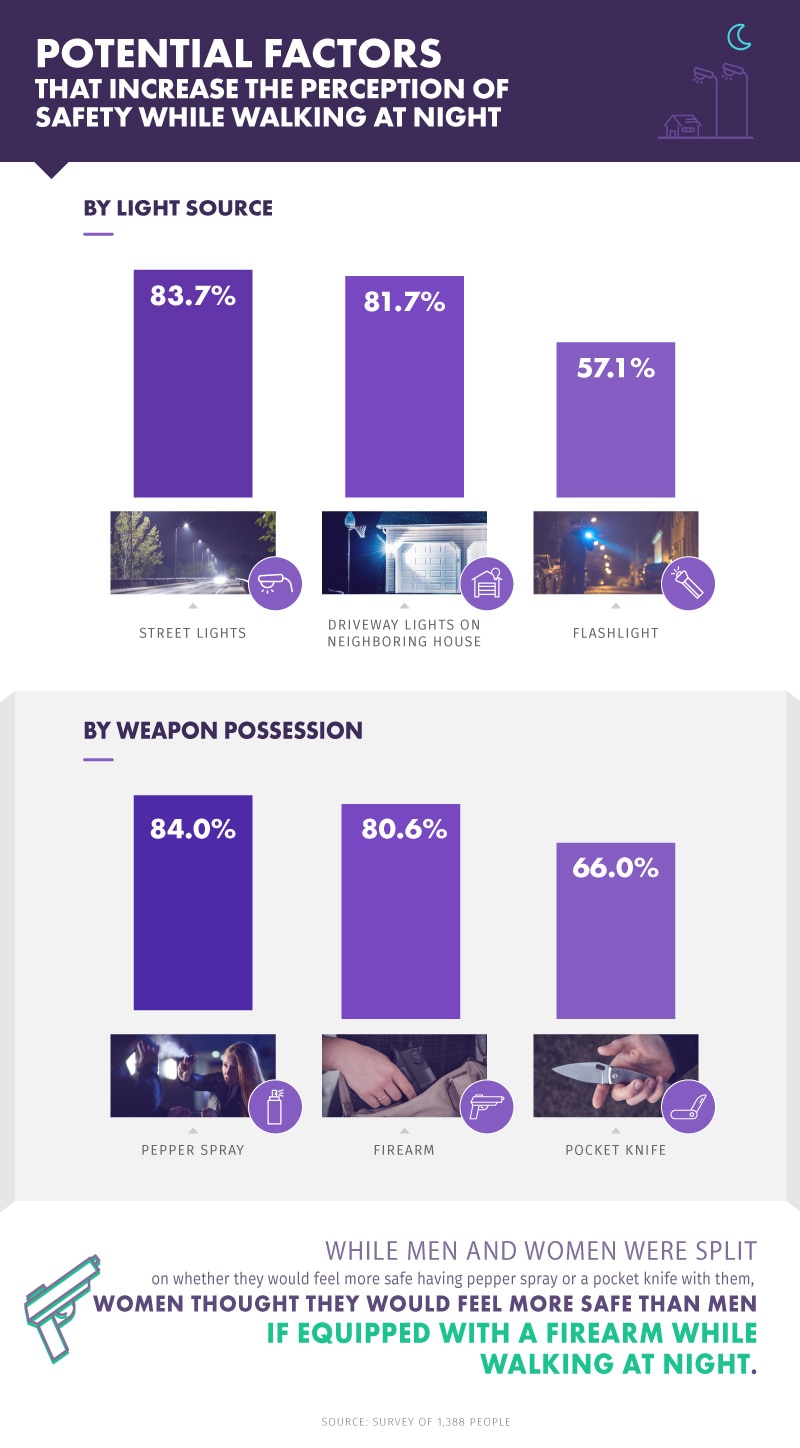
There are ways for both men and women to feel safer when walking at night, chief among them are streetlights. Almost 84 percent of men and women hope their evening stroll is accompanied by the glow of incandescent or LED street lamps. While cities and government officials have boasted about the importance of lighting as a deterrent to criminal activity, the true impact of streetlights isn't usually met with a concrete reduction in crime rates.
Physical forms of protection are another way both men and women felt safer when walking alone at night. 84 percent of men and women find carrying pepper spray comforting, more than either a firearm or pocket knife. With effects that can last between 30 to 45 minutes, ranging from temporary blindness to shortness of breath, pepper spray is also recommended by the National Center on Domestic and Sexual Violence to help deter related crimes.
Environmental Factors
Nearly 69 percent of those surveyed said severe thunderstorms concern them the most of all weather-related occurrences. The National Severe Storms Laboratory uses the following criteria to classify a thunderstorm as severe: "hail one inch or greater, winds gusting in excess of 50 knots/57.5 mph, or a tornado." Those severe thunderstorm warnings, issued by the local National Oceanic and Atmospheric Administration, "pose a serious threat to life and property to those in the path of the storm."
Snowstorms, sometimes referred to as winter storms, bring "extreme cold, freezing rain, snow, ice, and high winds." The Department of Homeland Security highlights "car accidents, hypothermia, frostbite, carbon monoxide poisoning, and heart attacks from overexertion" as many of the issues stemming from snow or winter storms to be aware of –especially considering nearly 51 percent of respondents found it to be the second-most-frightening severe weather event.
Regional Security Efforts
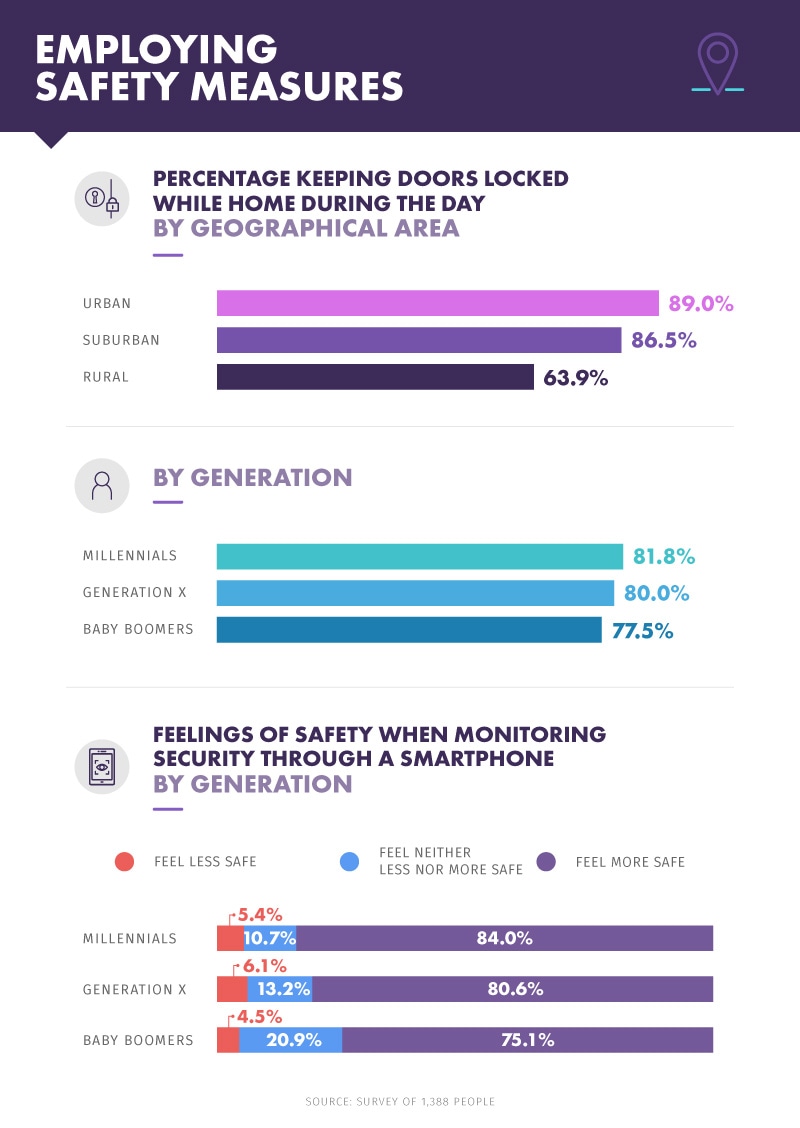
"Come on in, it's open" isn't a phrase you might expect to hear from individuals living in urban or suburban environments. 89 percent of those living in urban areas and close to 87 percent of those in suburban settings said they keep their doors locked while at home. This is in stark contrast to the roughly 64 percent of rural residents who keep their doors locked.
Younger consumers found themselves more willing to leverage modern technology, such as a smartphone, to keep an eye on their home. 84 percent of millennials felt safer when having the ability to monitor and manage their home's safety through an app or other connected service. It was very uncommon across all generations to feel less safe by implementing protection provided by these modern-day options.
Regional Security Concerns
Are you okay walking your dog alone when it's dark outside, or is okay to leave the front door unlocked from time to time? And how do your neighbors feel?
Using this interactive map, you can explore the safety concerns of your state and how they compare to the rest of the nation ranging from arson to assault and robbery. Simply click on the crime type at the top of the map, and you'll have access to state-wide worry by both neighborhoods and major cities. Our map will show you individual responses based on both region and crime in relation to the rest of the country.
Feeling Safe at Home
No matter how it happens, home is where you're supposed to feel safe. As the place we retreat to at the end of a long day and the spot where we connect most often with our family and friends, there's a physical and emotional component to how we feel protected by the comfort of our own homes. And even as security technology continues to innovate and reinvent how we approach that safety, the things that helped people feel the most secure were often the most fundamental aspects of security: a deadbolt, an alarm system, and surveillance cameras.
Of course, there's more to feeling safe at home than the way you outfit your house. Our neighborhoods, communities, and even weather patterns tend to play a large role in how we think about safety outside our front door. Understanding the kinds of hazards that are more common where you live could be the key to preparing appropriately and creating true peace of mind whether you're planning on staying in or heading out for the night.
Sources
- https://www.engadget.com/2018/01/07/xenoma-smart-clothing-dementia/
- https://venturebeat.com/2017/10/12/robotic-monitoring-and-ai-powered-surveillance-are-changing-home-security/
- https://www.huffingtonpost.com/paul-dunion-edd-lpc/feeling-secure-vs-being-s_b_10596374.html
- https://www.consumerreports.org/door-locks/door-locks-that-keep-you-safe/
- https://www.rd.com/home/improvement/burglar-secrets/
- https://www.seattletimes.com/seattle-news/data/mean-world-syndrome-in-some-seattle-neighborhoods-fear-of-crime-exceeds-reality/
- https://www.verywellfit.com/night-walking-strategies-3436861
- https://www.adt.com/crime
- https://www.cityofsacramento.org/Police/Resources/Safety-and-Crime-Prevention-Tips
- https://twitter.com/Timothy_Cama/status/926064308957655041
- https://www.washingtonpost.com/news/wonk/wp/2017/11/02/what-actually-happens-to-crime-when-the-lights-are-on-as-rick-perry-suggests
- https://www.medicalnewstoday.com/articles/238262.php
- http://www.ncdsv.org/images/Self-Defense%20FAQ.pdf
- https://www.nssl.noaa.gov/education/svrwx101/thunderstorms/
- https://www.weather.gov/
- https://www.ready.gov/winter-weather
Methodology
We collected 1,388 participants from Amazon's Mechanical Turk. 44 percent of our participants were men, and 56 percent were women. 14.9 percent of our participants were baby boomers, 28 percent were Gen Xers, and 57.1 percent were millennials. 29.1 percent of our participants lived in rural areas, 45.9 percent lived in suburban areas, and 25 percent lived in urban areas. 18.3 percent of our participants lived alone, 21.1 percent lived with a roommate, and 60.6 percent lived with a significant other. Participants ranged in age from 19 to 80 with a mean of 38.1 and a standard deviation of 12.2. Demographics without an adequate sample size were excluded from analysis. We weighted the data to the 2016 U.S. census for age, gender, and state of residence.
| State | Count | State | Count |
|---|---|---|---|
| Alabama | 29 | Montana | 26 |
| Alaska | 26 | Nebraska | 28 |
| Arizona | 27 | Nevada | 29 |
| Arkansas | 26 | New Hampshire | 27 |
| California | 57 | New Jersey | 26 |
| Colorado | 29 | New Mexico | 28 |
| Connecticut | 26 | New York | 26 |
| Delaware | 29 | North Carolina | 28 |
| Florida | 35 | North Dakota | 24 |
| Georgia | 26 | Ohio | 27 |
| Hawaii | 30 | Oklahoma | 26 |
| Idaho | 28 | Oregon | 26 |
| Illinois | 26 | Pennsylvania | 27 |
| Indiana | 27 | Rhode Island | 26 |
| Iowa | 26 | South Carolina | 28 |
| Kansas | 26 | South Dakota | 28 |
| Kentucky | 26 | Tennessee | 26 |
| Louisiana | 52 | Texas | 32 |
| Maine | 27 | Utah | 26 |
| Maryland | 26 | Vermont | 26 |
| Massachusetts | 31 | Virginia | 26 |
| Michigan | 26 | Washington | 26 |
| Minnesota | 26 | West Virginia | 27 |
| Mississippi | 29 | Wisconsin | 28 |
| Missouri | 28 | Wyoming | 26 |
Limitations
The sample sizes for North Dakota was 24, with more participants from this state, we could have gained more insight into this population.The data we are presenting rely solely on self-reporting which can introduce issues such as, but not limited to, selective memory, telescoping, attribution, and exaggeration. No statistical testing was performed so all claims are made on means alone. The content presented is exploratory and opens the door for future research to be more rigorous.
Fair Use Statement
Sometimes it takes the whole community to feel safe. We welcome the sharing of our study's findings for any noncommercial use. In an effort to ensure the contributors of this article receive recognition for their work, we ask that you include a link back to this page in your post.
This information is provided for general informational purposes only and should not be relied on in making any buying decisions. Information is deemed reliable but not guaranteed.
© 2019 ADT LLC dba ADT Security Services. All rights reserved. ADT, the ADT logo, ADT Always There and 800.ADT.ASAP and the product/service names listed in this document are marks and/or registered marks. Third party marks are the property of their respective owners.